CGSI 2026
Applications to phylogenetics
Filippo Monti
UCLA Biostatistics
Interactive demonstration
The live version opens a one-tip nucleotide-only tree view.
Interactive demonstration
The live version opens the app-only interactive tree view.
| · | qAT | qAC | qAG |
| qTA | · | qTC | qTG |
| qCA | qCT | · | qCG |
| qGA | qGT | qGC | · |
| · | q12 | q13 | q14 | q15 | q16 | q17 |
| q21 | · | q23 | q24 | q25 | q26 | q27 |
| q31 | q32 | · | q34 | q35 | q36 | q37 |
| q41 | q42 | q43 | · | q45 | q46 | q47 |
| q51 | q52 | q53 | q54 | · | q56 | q57 |
| q61 | q62 | q63 | q64 | q65 | · | q67 |
| q71 | q72 | q73 | q74 | q75 | q76 | · |
Gaussian process model:
log(qij)=f(xij)+ϵ,f(⋅)∼GP(0,K(⋅,⋅)).Example: xij is the population density of country i
Qgeo =| · | q12 ( x12 ) | q13 ( x13 ) | q14 ( x14 ) | q15 ( x15 ) | q16 ( x16 ) | q17 ( x17 ) |
| q21 ( x21 ) | · | q23 ( x23 ) | q24 ( x24 ) | q25 ( x25 ) | q26 ( x26 ) | q27 ( x27 ) |
| q31 ( x31 ) | q32 ( x32 ) | · | q34 ( x34 ) | q35 ( x35 ) | q36 ( x36 ) | q37 ( x37 ) |
| q41 ( x41 ) | q42 ( x42 ) | q43 ( x43 ) | · | q45 ( x45 ) | q46 ( x46 ) | q47 ( x47 ) |
| q51 ( x51 ) | q52 ( x52 ) | q53 ( x53 ) | q54 ( x54 ) | · | q56 ( x56 ) | q57 ( x57 ) |
| q61 ( x61 ) | q62 ( x62 ) | q63 ( x63 ) | q64 ( x64 ) | q65 ( x65 ) | · | q67 ( x67 ) |
| q71 ( x71 ) | q72 ( x72 ) | q73 ( x73 ) | q74 ( x74 ) | q75 ( x75 ) | q76 ( x76 ) | · |

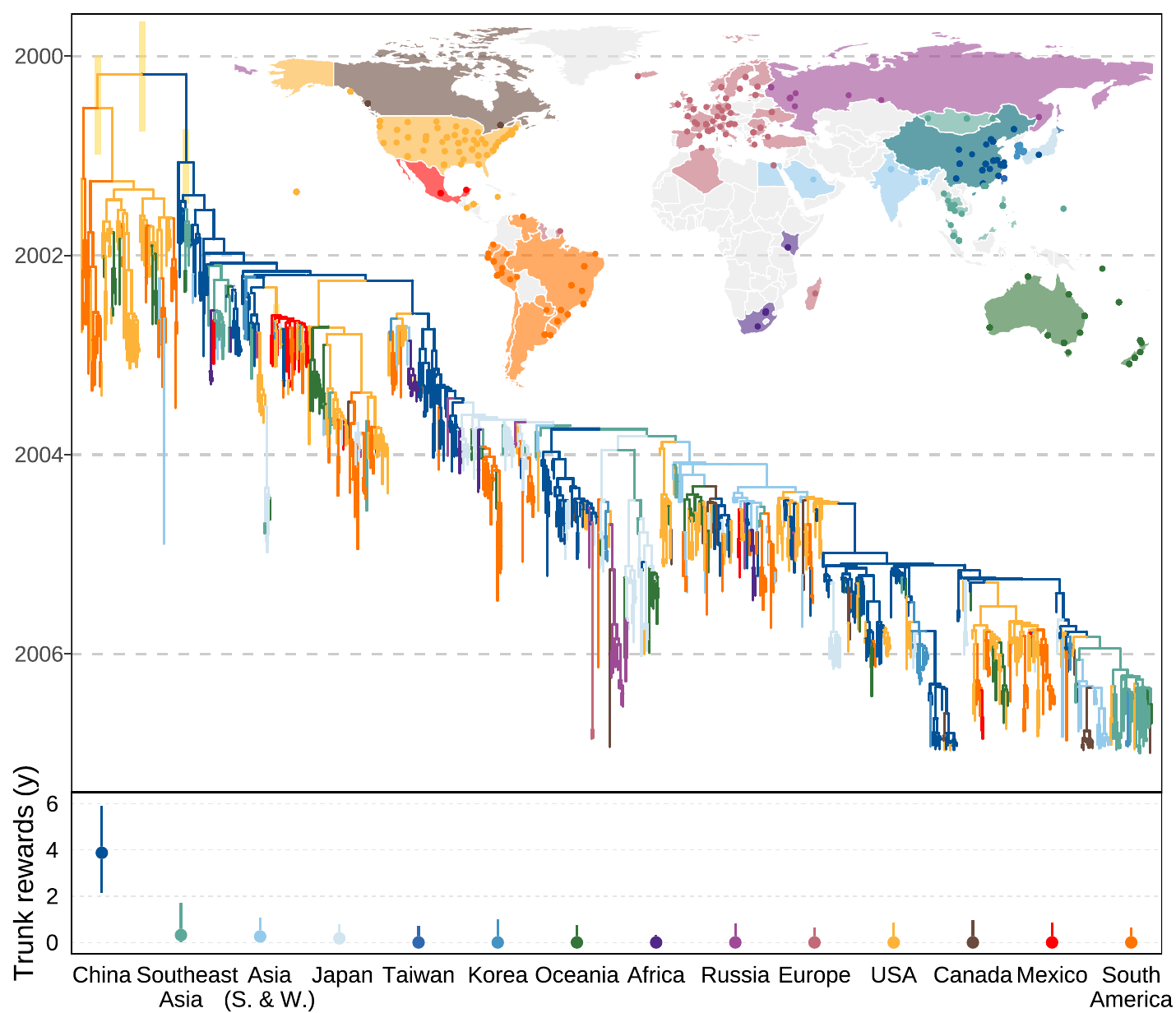
1441 H3N2 hemagglutinin sequences + locations
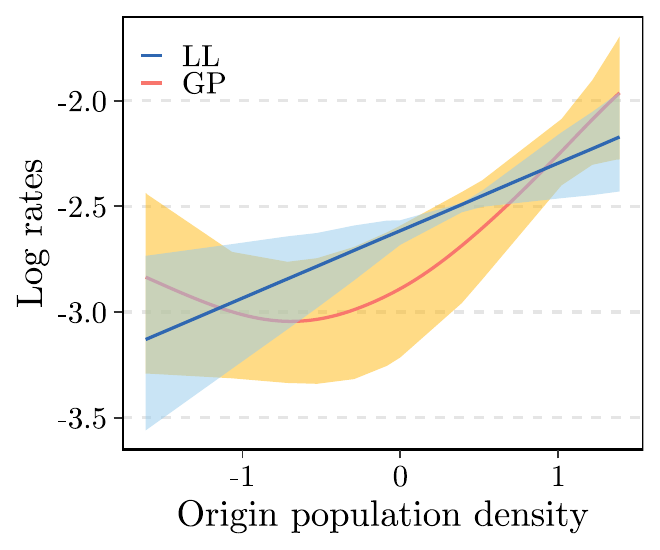

Monti, F., Ji, X., Shao, Y., and Suchard, M. A. (2026). Nonparametric Modeling of Continuous-Time Markov Chains with Scalable Exact and Approximate Gradients.
Let N be the number of observations and K the number of states.
Q has K2 highly dependent entries → gradient-based inference.
Q enters the likelihood through etQ:=∑n=0∞n!(tQ)n.
The gradient of etQ is super expensive:
New adjoint-based matrix-exponential gradient to get:
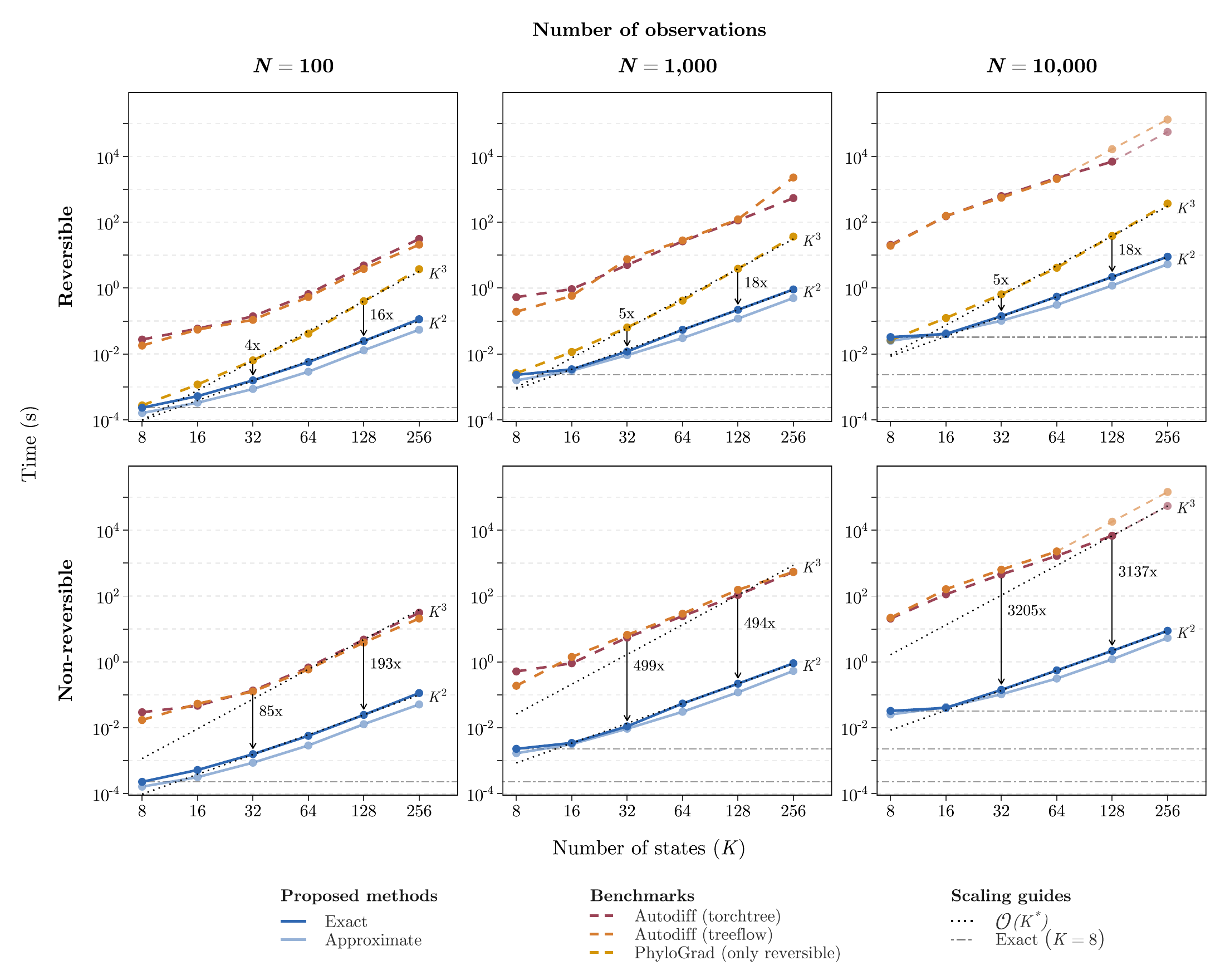
Monti, F., Ji, X., Shao, Y., and Suchard, M. A. (2026). Nonparametric Modeling of Continuous-Time Markov Chains with Scalable Exact and Approximate Gradients.
Evolving traits: body size, head, forelimb, hindlimb, lamellae, and tail.
(1) S must be (Hurwitz) stable: (Re(λ)≤0)
(2) computational complexity of branch variances(lots of etS);
Current scalable solutions: diagonal or symmetric parametrizations
But: they can only describe “monotone” evolution
Using Schur blocks:
But: need to pre-specify the number of complex conjugate pairs
A matrix S∈RK×K is represented under the Hurwitz-smooth spectral block parametrization (H-SSBP) if it can be written as
where B=bdiag(B1,…,BnB) is block diagonal, with
If K is odd, one block is scalar.
Smooth transition between coupled complex eigenvalues and decoupled real eigenvalues
Stability is guaranteed by ρb<0,θb∈[−4π,4π]
Matrix support: all matrices diagonalizable over C and some defective cases ⟹ full Lebesgue measure over the stable cone
Monti, F., Holbrook, A., Glatt-Holtz, N. E., and Suchard, M. A. (2026+). Stable Matrix Parametrizations and Structured Adjoints for Ornstein—Uhlenbeck Processes.
State of the art:Gaussian message passing algorithm
Using H-SSBP:
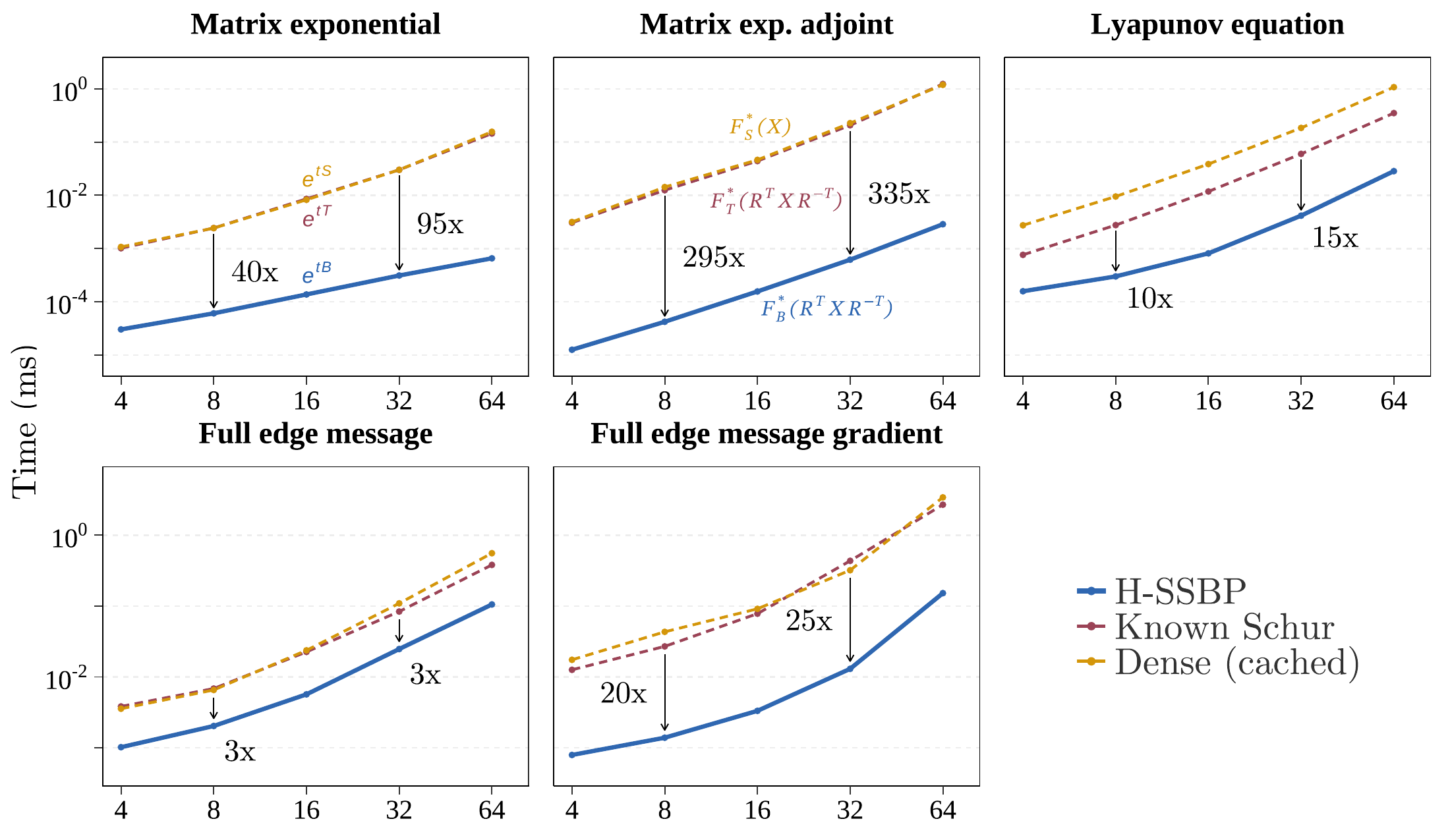
Monti, F., Holbrook, A., Glatt-Holtz, N. E., and Suchard, M. A. (2026+). Stable Matrix Parametrizations and Structured Adjoints for Ornstein—Uhlenbeck Processes.
Advisor: Marc Suchard
Collaborators: Xiang Ji, Yucai Shao, Andrew Holbrook, and Nathan Edward Glatt-Holtz.
Funding:
National Institutes of Health grants U19 AI135995, R01 AI153044, and R01 AI162611.